Recap of the UX Winter School 2026
The Winter School that KMH GmbH made possible for me is now over, and all four workshops were super exciting and very hands-on. I learned something new in every single one and met a lot of new, inspiring people. Susan Rittel, who I attended UX Summer School 2025 with, was even there too!
We learned across four topic blocks:
- A condensed run through Design Thinking (3 hours)
- Experiencing accessibility firsthand, on our own bodies
- Behavioral psychology in design
- Gamification
A condensed run through Design Thinking (3 hours)
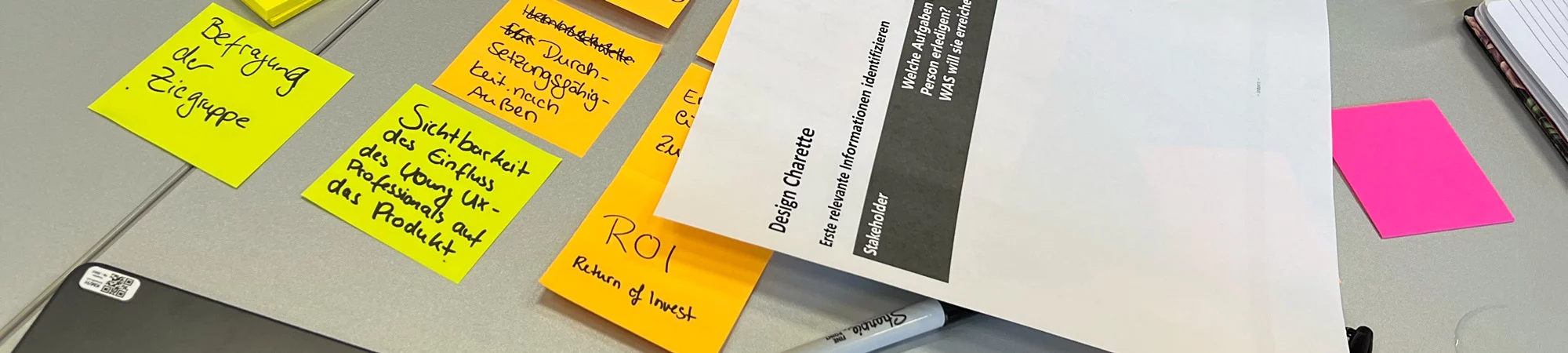
In the Design Thinking workshop with Rebekka Schüler and Maximilian Steiner from DATEV eG, we had to develop a prototype together within three hours. In the process, we learned a new method for developing ideas.
Pulled out of the context of our problem statement, we had to compare a real object to our problem and form associations. That produced some really interesting parallels. I never would have imagined beforehand that an electric heater could have so much in common with the professional challenges young UX designers face 😂.
Together, we developed a prototype in a speed-run. Our result: a game for the next design workshop at our own company. I found the idea so exciting that I definitely want to keep working on it. I'm curious when we'll meet again (remotely) to pick it back up.
And that's exactly what our Winter School, organized by the German UPA, is ideal for: networking and staying networked 🤝.
Experiencing accessibility firsthand, on our own bodies
The next workshop, led by Till Wollong on accessibility, was very hands-on. First we covered the basics and terminology around the topic, before moving into practice. To build awareness, we put on glasses that simulated various eye conditions.
Those were some very frustrating hours of trying to use a device. With the cataract simulation, I couldn't even manage to unlock my MacBook, and I'd rather not talk about the headaches I got within a few minutes. There's definitely room to make things more user-friendly here.
Did you know?
Accessible design has high innovation potential. It doesn't just affect people with impairments – it can also offer a high degree of comfort to everyone else.
Limitations can affect any of us as we age. We're already designing for our own future right now!
Behavioral psychology in design
In the behavioral psychology workshop with Dr. Natalie Woletz, we talked about how important the different mental models of our users are. A small experiment made that immediately clear:
Half of the participants were used to scrolling on a touchpad from bottom to top, the other half exactly the other way around.
That sounds trivial, but it has enormous effects on usability and the expectations people bring to our products.
We then discussed the impact that removing just a single decision can have on how a system gets used. In the case of a university in the US, a large share of students didn't apply for state financial aid. Why? Because it's often that one extra decision that keeps us from taking action. When students were told it was part of the university enrollment process, three times as many students applied for their financial aid compared to before.
Did you know?
We humans make between 70–200 decisions every day (depending on the study). This raises the question for me of whether that figure applies equally to neurodivergent people (e.g., ADHD) or not.
Gamification
In the last workshop, Roman Rackwitz told us about one of his favorite client projects and how he managed to make wine tasting more engaging through gamification. It was genuinely a super smart idea. 😁
We then discussed how we could use gamification in our own products and got a toolbox to take with us.
What was new for me was the point that gamification ≠ a reward system. If we removed all the rewards from casual games, would we still play them? Would they still be fun? Not necessarily.
And that's exactly what we want to achieve with gamification design: products with a certain level of challenge that are fun even without rewards, coins, and badges.
But how do you actually get people to feel curiosity (spark ✨) in the first place? Aren't we already numbed by algorithms and the like? A good question, which Roman was able to answer directly. I'm curious to try out how and where I can break patterns to spark curiosity.
I learned that efficiency is sometimes, but not always, the right call. And that sometimes it's better to give users a brief moment to breathe, instead of always delivering results immediately.
My highlight at the end, of course, was getting Roman's first edition of his book "Drive Method," signed.
That is going to stick in my memory, for sure!